Taormina Greek Theatre History
Who built the Ancient Theatre of Taormina, why the ruin you see is mostly Roman, what the cavea, orchestra and stage are, and why capacity figures vary.
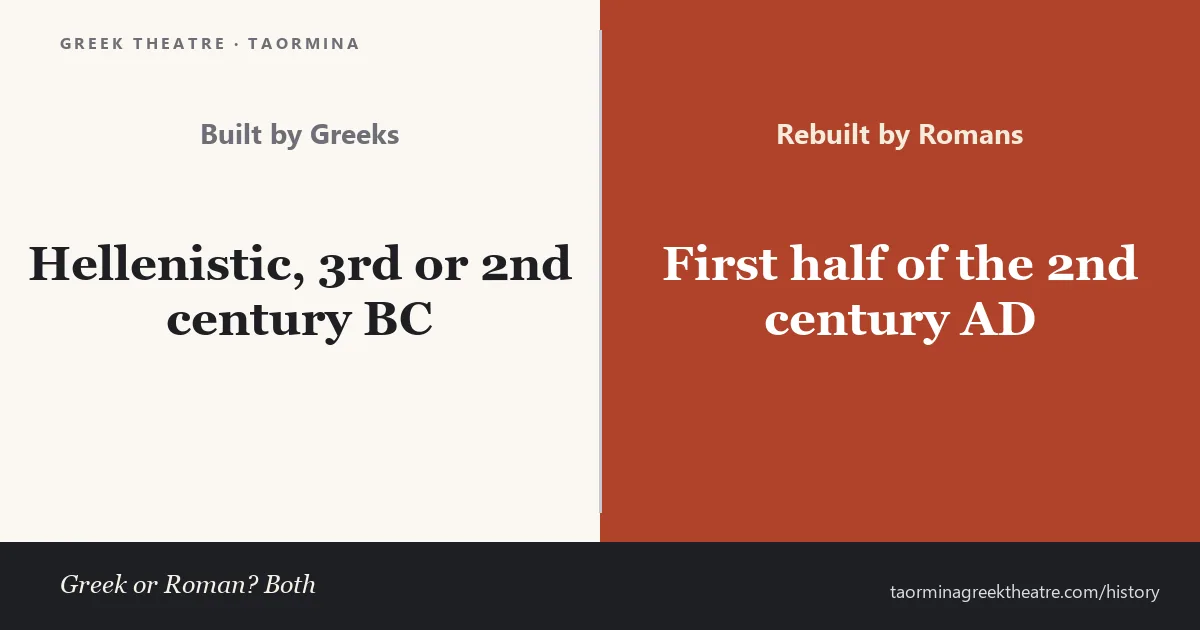
The theatre is both Greek and Roman. Greeks built the first theatre on this hill in the Hellenistic period, in the 3rd or possibly the 2nd century BC. Almost everything you see today comes from a Roman rebuild in the first half of the 2nd century AD, under Trajan or Hadrian. The archaeological park that runs the site describes it in exactly those terms, so “Greek Theatre” names its origin and the brick ruin in front of you is Roman work.
It is the second-largest ancient theatre in Sicily after the one in Syracuse, with a seating bowl about 109 metres across by the park’s measurement. The setting is the reason people come: from the upper rows you look through the broken stage wall to Mount Etna and the Ionian coast.
Check Availability
Greek or Roman: what each period left
The Greek theatre came first. The park dates it to the 3rd or 2nd century BC from two pieces of evidence still on site: the remains of a wall built in squared blocks and some seats carved with inscriptions. Wikipedia puts it at around the 3rd century BC. That fits the town’s own story. Ancient Tauromenion was refounded in about 358 BC by Andromachus, who gathered survivors of Naxos, the Greek colony on the coast below, after Syracuse had destroyed it. So the town was a Greek city for a century or more before anyone built a stone theatre here.
The Romans then remade it. In the first half of the 2nd century AD the theatre was rebuilt almost from scratch and the seating bowl enlarged. Later, between the 2nd and 3rd centuries AD, it was changed again for a new kind of show: the flat floor became an arena, with a ring corridor and an underground room that may have held equipment and animal cages, and a portico was added behind the stage.
On your visit, read the brick stage wall and most of what stands around it as Roman. The Greek phase survives in fragments you only spot if you know to look for them, which is the main thing a live guide adds here.
What you see inside: cavea, orchestra and scaena
Three parts make up the theatre, and they are easy to tell apart once you are standing in it.
| Part | What it is | What to look for |
|---|---|---|
| Cavea | The curved seating bowl, about 109 m across (other sources give 107 m) | Climb to the top rows for the view over the stage, a steep few minutes on uneven steps that leaves most people out of breath in summer heat; Wikipedia describes it as divided into nine wedge-shaped sections |
| Orchestra | The flat half-circle at the foot of the seats | In the Roman arena phase this floor became the fighting ground |
| Scaena | The stage building and its tall back wall | Two side openings still stand; the central one collapsed. The columns were put back up in a 19th-century restoration |
Wikipedia also records a basilica, a large hall, on each side of the stage building. Near the entrance stands the Casina degli Inglesi, a 19th-century building that once served as the site museum and now holds Taormina’s collection of inscriptions, mostly Greek public documents from the 2nd and 1st centuries BC. The park does not say whether visitors can go inside, so treat it as a maybe on the day.
Two details help when you look around. The columns you photograph are partly a 19th-century rebuild, not untouched Roman work. And the gap in the middle of the stage wall is a collapse; the view through it was not designed.
How many people did it hold?
Nobody agrees on a number. Wikipedia gives about 10,000; estimates based on the work of the theatre historian Frank Sear run from roughly 8,900 to 11,150; and some travel sites print 5,400. Treat any single figure you read as one estimate among several. For concerts today, one Italian travel site says the seating is limited to about 4,500 for comfort and safety, and we found no official figure to confirm it.
What you can rely on is the size of the bowl. At about 109 metres across it is the second-largest ancient theatre in Sicily. The theatre in Syracuse is wider, at about 138 metres, and much of it is cut into the rock. If you are choosing between the two, our Taormina vs Syracuse comparison sets them side by side.
The view of Etna and the coast
The reason the theatre is famous has little to do with its size. It sits high above the sea, and from the upper seats you look over the stage ruins to the Ionian coast and, on a clear day, to Etna. Goethe came here in May 1787 and wrote in his Italian Journey that no theatre audience had ever looked out on such a view; translations of the line vary, but the meaning holds.
Haze often softens Etna, especially on warm afternoons, so a clear view is never guaranteed. For where to stand and when the light works, see the photography guide, and for the time of year, when to visit.
The theatre since antiquity
The theatre has a working life in the present, too. Each summer it hosts concerts, and the Taormina Film Fest took over the site from 10 to 14 June 2026. Directors have used it as a set: Woody Allen filmed scenes of Mighty Aphrodite (1995) here, and it appears in season two of The White Lotus. The concerts and events page lists what is known for next summer.
That modern use has a cost for day visitors. Stages, lighting rigs and seating go in for the season, and on show days parts of the monument can close or keep shorter hours.
Know before you go
- Admission is €14 full price, €7 reduced for EU citizens aged 18 to 25, and free under 18 (checked November 2026; confirm on the park’s own site). Prices and free days are on the tickets page.
- The park publishes 9:00 to 19:45 with last entry at 19:00, but the theatre closes much earlier in winter. Travel guides give about 16:00 from November to mid-February; check the opening hours before you go.
- No information panel will tell you which stones are Greek. If the history is why you are going, a guide helps more than a ticket alone.
- Expect steps and uneven ancient paving; see accessibility if that matters to your group.
Seeing the history with a guide
The Ancient Theatre ticket with guided tour costs from about $34 per person (checked November 2026) and includes entry and a live guide in English or Italian, listed at 50 minutes. Be aware that it rates 4.0/5 from 452 reviews; reviewers mention late guides, mixed English and Italian groups and tours that ran short (our review). If you would rather go at your own pace, the Ancient Theatre ticket with audio guide is about $25 per person, and the plain gate ticket is €14. Our audio guide vs guided tour page helps you pick, and the guided tours page covers the walking tours that take in the town as well.
Pick Your Day at the Greek Theatre
Choose a date, pick up the audio guide at the theatre and explore at your own pace. Prices checked in November 2026.
Check Tickets & Dates